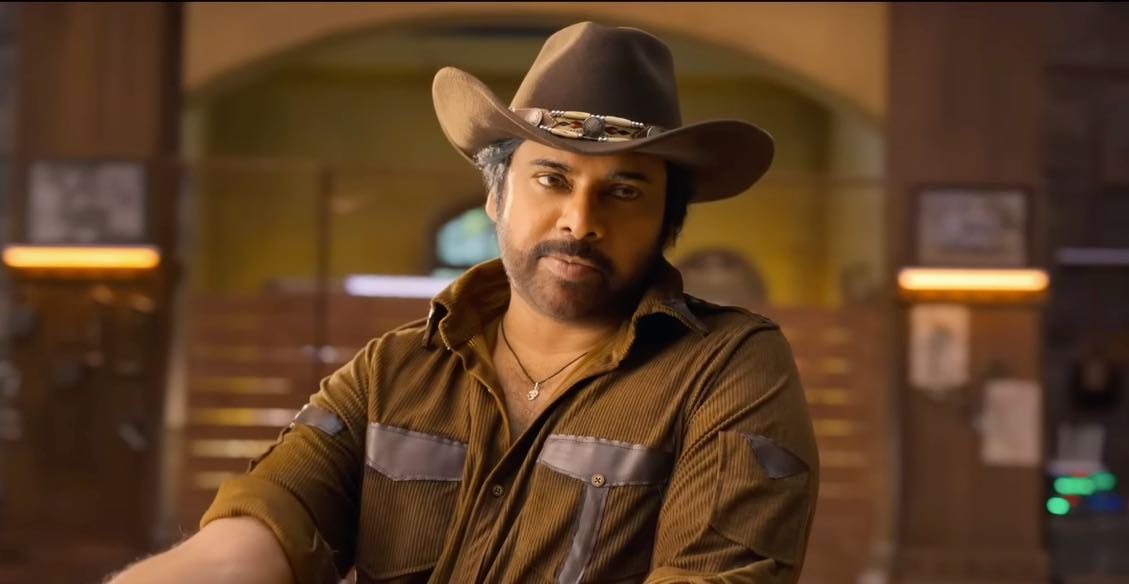
Ustaad Bhagat Singh Review – Outdated and Entertains Rarely
After delivering a cult commercial blockbuster with Gabbar Singh, the combination of Pawan Kalyan and Harish Shankar returns with Ustaad Bhagat Singh, a film that leans heavily into the star’s charisma and mass appeal. Positioned as a socially conscious action drama, the film attempts to blend emotion, politics, and commercial elements. While it succeeds in parts—particularly in the latter half, it remains inconsistent in its overall execution.
Synopsis
Set in the tribal regions of the erstwhile Andhra Pradesh, the narrative follows an idealistic teacher (K. S. Ravikumar) who mentors a courageous young boy, shaping him into Ustaad Bhagat Singh (Pawan Kalyan)—a man guided by education, integrity, and a strong moral compass. As Bhagat grows into a principled police officer and his mentor rises to the position of Chief Minister, their shared vision for justice begins to unsettle entrenched powers.
An assassination attempt on the Chief Minister draws Bhagat into a complex web of political conspiracy, personal relationships, and ethical dilemmas. With his life intertwined with RJ Geetha and the enigmatic Shloka, Bhagat must confront the formidable Nagappa and his sons, all while bearing the burden of remaining steadfast in a deeply compromised system.
Performances
Pawan Kalyan delivers one of his more engaging performances in recent years, balancing style, humour, emotion, and mass appeal with notable ease. His screen presence remains commanding, complemented by improved agility in dance, a return to his comic timing, and a compelling emotional stretch preceding the climax. His confrontational sequences retain his signature intensity.
R. Parthiban is effective as the antagonist, exuding a restrained menace, while K. S. Ravikumar offers a dignified and measured performance as the teacher-turned-Chief Minister. Sreeleela performs capably as the spirited RJ, and her on-screen pairing with Pawan Kalyan is handled with maturity, avoiding any sense of mismatch. Raashii Khanna, however, is afforded limited scope, resulting in a rather understated presence.
Among the supporting cast, Ramki and Gautami make brief yet noticeable appearances, while L. B. Sriram lends emotional depth to his scenes. Rao Ramesh plays a pivotal role with an interesting turn, although his initial portions verge on exaggeration. The comedic track involving Satyam Rajesh, Prabhas Sreenu, and Chammak Chandra largely feels redundant, adding little of substance to the narrative.
Technical Aspects
Devi Sri Prasad, known for delivering several memorable albums for Pawan Kalyan in the past, provides a largely underwhelming soundtrack on this occasion. Thaman S’s background score is functional but lacks the dynamism required to elevate key moments.
Ayananka Bose’s cinematography emerges as a notable strength, effectively capturing the verdant landscapes and expansive sets with visual finesse, supported by consistent colour grading. In contrast, Karthika Srinivas’s editing appears uneven, particularly in the first half where the pacing tends to falter. Nevertheless, Mythri Movie Makers maintain high production standards, ensuring a visually polished presentation throughout.
Analysis
The film’s principal drawback lies in its opening hour, where the narrative progression, humour, and dramatic elements appear dated and insufficiently engaging. The writing and execution in these segments lack sharpness, with certain sequences feeling misplaced and ineffective. Additionally, a particular stretch comes across as derivative, further affecting the film’s freshness.
That said, the second half offers some redemption through three well-crafted segments—the Old City episode, the police station sequence, and a key confrontation involving the antagonist’s son. These portions are executed with commendable intensity and cater effectively to the sensibilities of the mass audience.
The writing, while inconsistent, succeeds intermittently through impactful moments that enhance the film’s emotional and dramatic weight. The incorporation of a familiar classic track in place of a conventional duet is handled with restraint, integrating seamlessly into the narrative.
Overall, Ustaad Bhagat Singh provides select moments of engagement, particularly for admirers of Pawan Kalyan, yet falls short of the benchmark set by Gabbar Singh. While the lead actor’s presence sustains the film to an extent, its reliance on formulaic storytelling limits its broader appeal.
Ustaad Bhagat Singh Review
-
SF Rating
-
Audience rating Be the first to rate →
Summary
Verdict: Timeworn Commercial Story that rarely entertains. Maybe, a treat for Pawan Kalyan fans