Thaai Kizhavi Movie Review – Humour Meets Heartland
Thaai Kizhavi, directed by Sivakumar Murugesan, is a rural family entertainer headlined by Radikaa Sarathkumar in a commanding central role. Featuring Singampuli, Aruldoss, Balasaravanan, Munishkanth, and Rachel Rebecca, the film blends comedy and emotion against a Madurai backdrop. With music by Nivas K. Prasanna and cinematography by Vivek Vijayakumar, the film attempts to package rustic chaos with heartfelt drama.
Synopsis
Pavunuthayi (Radikaa), a fierce and domineering elderly woman, lives with her separated daughter while running a ruthless money-lending business in the village. Feared for her abrasive collection methods, she keeps the villagers constantly on edge. When she unexpectedly loses consciousness and becomes bedridden, the very village that trembled before her reacts with visible relief. Her three estranged sons—Singampuli, Aruldoss, and Balasaravanan—return home reluctantly upon hearing of her condition. As Pavunuthayi struggles to communicate something crucial through gestures, the sons attempt to decipher her final message with the help of their relative Benny Quick (Munishkanth). The film revolves around whether she survives, what she intended to convey, and how that revelation alters her sons’ lives.
Performances
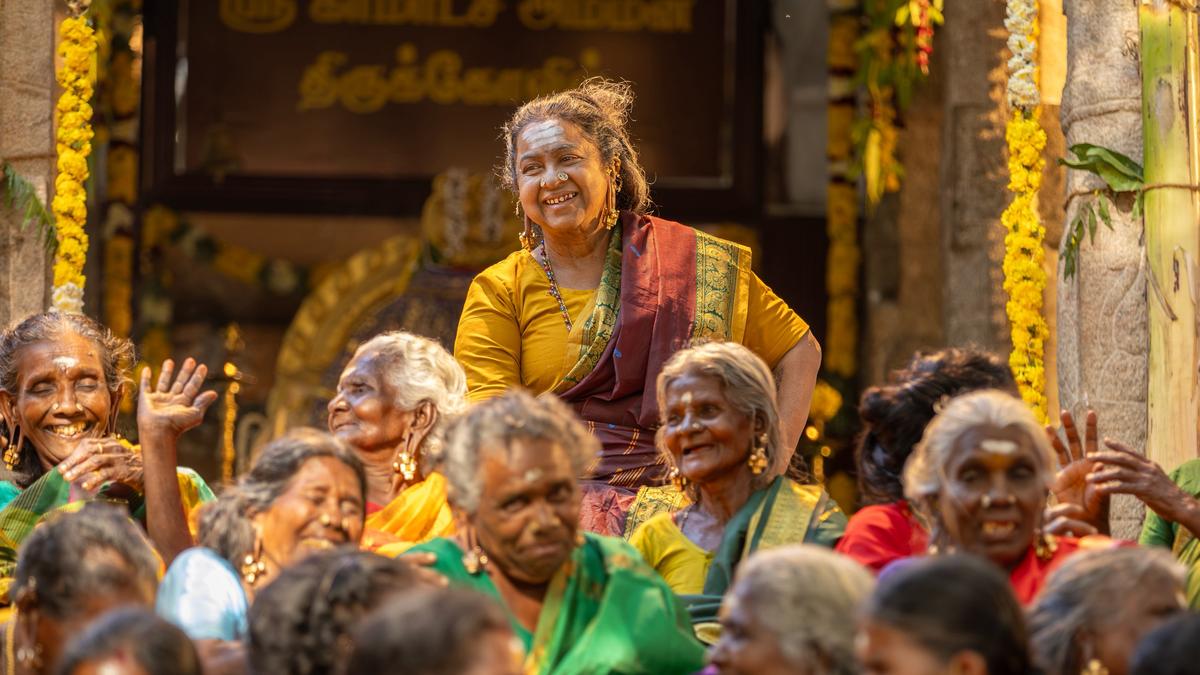
Radikaa breathes formidable life into Pavunuthayi. From her distinctive attire and mannerisms to her unyielding self-respect and commanding screen presence, she embodies the character with striking authenticity. Even in emotional stretches, her seasoned performance anchors the film with authority.
Singampuli, Aruldoss, and Balasaravanan convincingly portray sons driven by selfishness, greed, and helplessness, balancing comedy and sentiment effectively. Munishkanth, as the ever-helpful relative, not only contributes humour but also aids the screenplay’s progression. Rachel Rebecca delivers a restrained performance, while ‘Vettai’ Muthukumar, George Maryan, Ilavarasu, and the daughters-in-law—including Muthulakshmi, Nirosha, and Abinaya, offer dependable support.
Analysis
The screenplay begins by establishing the dynamics between Pavunuthayi and her village before shifting gears into full-fledged comedy once the sons arrive. Numerous supporting characters are introduced with distinctive traits and brief backstories, seamlessly woven into the narrative. While the first half progresses without major plot movement, it remains engaging through nuanced, comedic character explorations. Clever references to actor Kamal Haasan and his songs are used almost as narrative devices, adding a playful meta layer.
However, certain sequences deviate from the central storyline, momentarily diluting narrative focus. The heavy use of Madurai regional dialect and localized slang adds authenticity but occasionally feels excessive. The second half leans heavily toward comedy, with emotional beats interspersed. Though the humour lands effectively in parts, the writing sometimes exaggerates characters into caricatures, affecting realism. Emotional arcs are well-conceived but occasionally lose impact due to overlapping comedic treatment and frequent cinematic references.
Technical Aspects
Cinematographer Vivek Vijayakumar captures Vikramangalam’s lush yet arid landscape with striking realism, utilizing hills, village ponds, and temples to enrich the visual texture. Editor San Lokesh supports the pacing effectively. Nivas K. Prasanna’s music complements the rural milieu, with songs blending organically into the narrative and an energetic background score enhancing the comedic tone. Production designer Ramu Thangaraj ensures authenticity through meticulous detailing of homes, streets, posters, and vehicles. However, Radikaa’s prosthetic makeup appears slightly distracting in certain portions.
Plus and Minus
The film’s greatest strengths lie in its character writing, casting precision, and Radikaa’s commanding performance. The rooted setting, authentic dialect, lively humour, and thematic exploration of rural women’s economic independence, dignity, and physical labour add substance. On the downside, tonal imbalance between comedy and emotion, occasional narrative detours, exaggerated characterisation, and overuse of film references slightly weaken the overall impact.
Despite its uneven patches, Thaai Kizhavi emerges as an engaging rural entertainer powered by memorable characters and strong performances. By blending humour with reflections on self-respect, financial independence, and familial bonds, the film manages to entertain while offering thoughtful subtext beneath its rustic chaos.
Thaai Kizhavi Movie Review
-
Thaai Kizhavi Movie Ratings
Summary
Verdict: A Lively Entertainer with Good Performances.